DECOLONISING SETTLER-COLONIAL (MIND)STATES?
BY RACHEL JANE LIEBERT, JULY 2026
This month we launched an evaluation report of Gathering at the Gate - Opening a Can of Worms: Decolonising Settler-Colonial (Mind)States through White Ancestral Recovery. Below is a drawing of the findings, followed by the list of castings or learnings on the use of white ancestral recovery for decolonisation, including Matike Mai. The full final report can be accessed here.
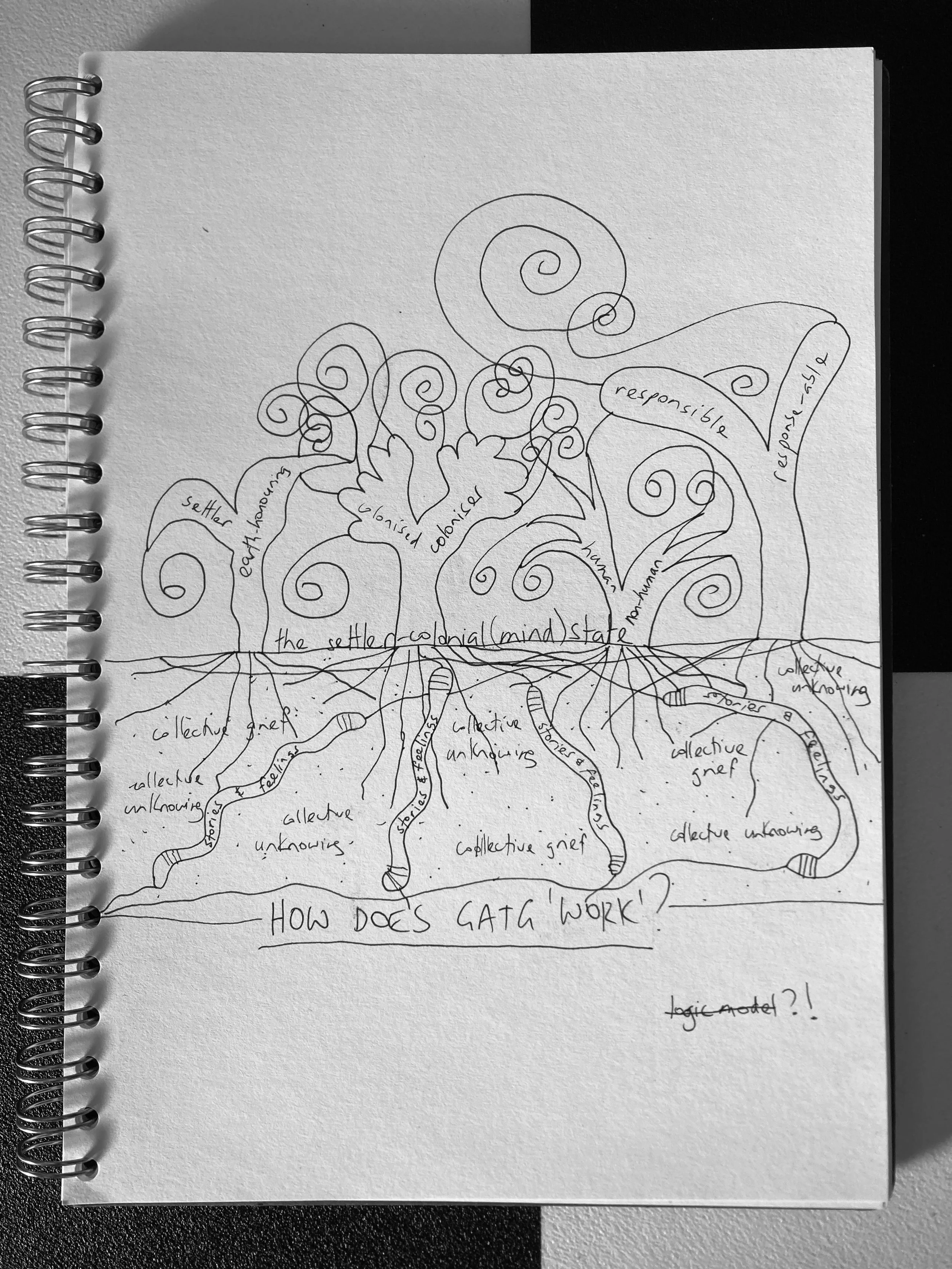
Drawing showing the bioturbation of GatG, reworking the settler colonial (mind)state through: (a) ‘worms’, releasing stories and feelings into the compacted dirt of ignorance and detachment; (b) ‘darkness & moisture’, sheltering these worms in a space of collective unknowing and grief; and (c) ‘transplanting’, inviting people to be both coloniser & colonised, settler & earth-honouring, human & more-than-human, responsible & response-able.
CASTINGS: LEARNINGS TOWARD DECOLONIALITY
If the above is how GatG works, what does this mean for the use of white ancestral recovery in decolonising movements? Returning to Moana Jackson’s ‘ethic of restoration’, GatG suggests that white ancestral recovery can assist in the restoration of the ‘hoped-for interdependence’ between Māori and Pākehā that TToW invokes[1]. However this is only if we remain vigilant about the ways that whiteness can turn ancestral recovery into a yet another practice of supremacy and coloniality. Ancestral recovery with white settler peoples needs to carefully attend to not just what is restored but also how. In what follows we offer some learnings on this process that have been left by this evaluation, as an offering ultimately toward Matike Mai.
First, given the ongoing role of ancestral reverence and earth-honouring practices in claims of racial ‘purity’ within white supremacist movements[2], white ancestral recovery requires relationship-building with both settler and earth-honouring ancestors, ensuring that the latter is not used to ignore the former and thus our own past and present role in settler colonial violence—supporting our responsibility.
Relatedly, relationships with earth-honouring ancestors must not be used to argue a sameness with Indigenous peoples or cultures, which can encourage attempted innocence or appropriation. Instead, white ancestral recovery should draw on ancestral resources for guidance on how to be in right relationship with Indigenous peoples—aka to support our response-ability (including our imagination) amidst settler colonial violence. in Aotearoa, this includes how to enact TToW and contribute to Matike Mai[3].
Third, white ancestral recovery must be approached through more than bloodlines if it is going to be decolonising—keep it queer and more-than-human. Restoring relationships with our non-blood and non-human ancestors helps to counter the role of the heteronormative nuclear family unit in coloniality[4], the abovementioned risk of ‘white purity’ and the anthropomorphism of the settler colonial state[5].
Relatedly, the settler colonial (mind)state needs to be unsettled ontologically as well as epistemologically. To be decolonising, white ancestral recovery requires more than knowledge; it must also address our ways of being and (therefore) relating. In turn, it needs to happen through the body and in community—even in what are conventionally thought of as only ‘intellectual’ activities (such as reading). Whether or not participants accept an invitation to attend to their bodies and work collectively, simply opening the possibility of a more-than-colonial way of being Pākehā (and of being ‘human’), interrupts the default disembodiment of the settler-colonial (mind)state[6].
Fifth, direct feedback during GatG from trans/queer, crip/sick/disabled and otherwise trauma-surviving participants reminded facilitators that even supposedly simple practices of embodiment (such as going outside, lying on the ground, attuning to our breath, scanning our bodies, putting our hand on our heart or stomach) can themselves be inaccessible, exclusive or triggering invitations. These intersections highlight the need to also counter cisheteropatriarchy and ableism in white ancestral recovery by continuing the gentle prioritisation of embodied activity in a way that is consensual, flexible and explicit—being in ongoing conversation with participants about the experience, encouraging adaptations and making clear the decolonial politics behind an embodied approach.
Sixth, the decolonising potential of white ancestral recovery includes its invitation to orient to our bodies as more-than-human, allowing white settler peoples to not just be in relation with but of the ecosphere—remembering, for example, that we once had earth-mamas, too. As above, this is not about claiming sameness with Indigenous peoples so much as tapping into something that could help us to be in right relationship. For example, more-than-human orientation toward our bodies enables our feelings to be approached less as something to be individually managed or feared (a tendency within mainstream intergenerational trauma praxes with white peoples[7]) and more as a tether to—or mirror into—something collective and otherwise that can help uproot us from the settler-colonial (mind)state (given its dependence on human supremacy[8]).
In GatG, this more-than-human sense is planted through the sit spot, however it could be further cultivated through the altar activities. Given people’s hesitancy, the altar could be introduced more slowly and explicitly in order to enable participants to be more open to its potential; for example, inviting a range of words, approaches or makings for what an ‘altar’ is and naming the building of and interaction with it as a gentle, experimental and embodied process that may seem simple but takes time and can often hit ‘blocks’—all of which is part of the learning experience (“Why might I, as a white settler person, have a block about engaging spirit or ancestors?”). For many participants, this will present an opportunity to critically engage the role of Christianity in our settler-colonial (mind)state – whether explicitly from the Church or more implicitly through mainstreamed and taken-for-granted cultural practices, values and assumptions in Pākehātanga.
Seventh, and relatedly, to be decolonising, white ancestral recovery needs to remind us that we are our ancestors. Doing so can help avoid the potential for white settler peoples to distance ourselves from the actions of our ancestors and thus our own ongoing complicity in settler colonial violence. It can also protect us from a tendency to position ourselves as somehow saving (including healing) our family lines, thereby repeating the colonial trope of the ‘white saviour’ who ‘knows best’.
This is important as, to be decolonising, white ancestral recovery needs to (humbly) reverberate through participants’ familial relationships—including with inherited stolen land. As GatG participants themselves asked, can white ancestral recovery build a movement? It was notable, for example, that participants spoke of increased conversations they had with family members about their ancestors but less about colonisation and decolonisation. And that they spoke with passion and gratitude about restoring relationships with Papatūānuku[9] but less so about restoring relationships with Māori. Could more work be done to connect belonging and response/ability in a settler colonial state? For example, participants could be more explicitly connected to Matike Mai and other Indigenous-led movements and/or encouraged to undertake decolonial action with their own communities, including landback. In terms of GatG, perhaps such action could be supported by inviting people to participate with a family member or other friend in decolonisation, or through cultivating a network of alumni and/or activist projects.
Ninth, white ancestral recovery can also assist decolonisation by orienting us to our descendants, enabling an intergenerational view of the ‘work’ of decolonisation. Such an approach can protect us from urgency, perfectionism and despair, and assist us to persist through and with messiness, discomfort and failure.
Tenth, ancestral recovery potentially offers a collective space for white settler peoples’ grief, ignorance and spirituality—all of which can do harm in spaces with Indigenous, Black and Brown peoples (by extracting emotional, intellectual and other kinds of labour). However, given the simultaneous necessity of white tears, unknowing and more-than-human-ness for decoloniality, and the scarcity of collective spaces for these to be engaged in ways that are safe and generative (i.e. contributing to decolonisation), white ancestral recovery needs to both heed and persevere through (important) critiques that such work is too artificial, privileged, naval-gazey or ‘woo woo’ to be decolonial; aka ‘spiritual bypassing’[10]. Show (over and over again) that it is possible to engage white settler peoples through grief, ignorance and spirituality while remaining staunchly grounded in the realities of settler colonial violence and in commitments to Indigenous sovereignty, including landback. As we say in TTP, “To commune with our ancestors we don’t need to dance around a maypole, but we do need a decolonial pou: Matike Mai”.
Eleventh, as mentioned above, GatG takes its name from the process whereby visitors gather at the gate of a marae before literally stepping into relationship with local Indigenous peoples and lands. Remember these roots too, and understand GatG as one part of a process through which people move in order to continue their fulfilment of TToW; a process that should itself not be overridden by colonial seductions of urgency and mastery. Instead be an explicit part of an exciting and growing ecosystem of practitioners committed to embodied and more-than-human modes of decolonisation internationally and in Aotearoa,including Manahau Embodied Movement[11] and The Pākehā Project[12]. Consider building explicit relationships with these groups in order to share learnings and synchronise offerings in solidarity.
Twelfth, GatG cannot be replicated or universalised—it is not a model nor a solution—to be so would be to ignore its own entanglement, risking the repetition of a colonial episteme that again overrides our relationality with desires for mastery. Instead, white ancestral recovery efforts need to be participatory, experimental and nimble—driven by reflexivity and humility.
For facilitators, this requires formalised relationships with people for critical and creative dialogue to keep the content and form of the course accountable and responsive to, in particular, Indigenous and other activists toward Matike Mai. It also requires that the course stays as grassroots as possible; deeply engaged in and with intersectional movements and resisting pressures to become bigger or richer, slicker or quicker.
[1] Jackson, M. (2021, May 9). Decolonisation and the stories in the land. E-Tangata.
[2] Gardell, M. (2003). Gods of the blood: The pagan revival and white separatism. Duke University Press.
[3] For an example of this process by Tauiwi of Colour, see Dam, L. (2023). Be(com)ing an Asian tangata tiriti. Kōtuitui: New Zealand Journal of Social Sciences Online, 18(3): 213-232.
[4] Lewis, S. (2022). Abolish the family: A manifesto for care and liberation. Verso Books.
[5] Marsden, M., & Royal, T. A. C. (2003). The Woven Universe: Selected Writings of Rev. Māori Marsden.
[6] Liebert, R. J. (2021). What could the white body do for decolonising psychology?Awry, 2(1): 99-123.
[7] E.g., Van der Kolk, B. (2014). The body keeps the score. Penguin Books.
[8] Marsden, M., & Royal, T. A. C. (2003). The Woven Universe: Selected Writings of Rev. Māori Marsden.
[9] The earthmother in Māori cosmology
[10] ‘Spiritual bypassing’ refers to a tendency within whiteness to claim that spiritual engagement allows – even requires – the ‘bypassing’ of concrete, political engagement
[11] www.kaiakindness.com
[12] www.pakehaproject.nz