Putting My Hand Up
I have spent the past few weeks trying to write a visionary statement for a fellowship application, and I want to tell you honestly: it is one of the weirdest forms of writing.
If you have never had the pleasure, a visionary statement asks you to write several hundred words about why you, specifically you, should lead. Your vision. Your trajectory. Your readiness. The word "I" appears more times in one page than most of us would use in a year. Every sentence is a small act of standing on a chair and pointing at yourself, and for me, every sentence came with a cringe I felt in my body before I could name it.
I sat with that discomfort, because I think it is worth taking seriously rather than pushing through. Some of it, sure, is the ordinary awkwardness anyone feels writing about themselves. But some of it is deeper and more specific. Many of us were raised inside a tikanga where whakaiti matters, where you do not carry your own kete of kūmara around telling people how sweet they are, where mana is something others recognise in you, never something you announce. The grant application does not know this. The grant application wants you to announce it, loudly, with evidence, in the third paragraph.
So there I was, a whare tangata and a daughter of Te Tai Rāwhiti, trying to write "I am ready to be an established research leader" without my tīpuna raising a collective eyebrow.
And then something shifted, and I want to share the shift because I suspect I am not the only one who needs it.
The shift was this. The vision was never mine to begin with, so I did not have to claim it. Matike Mai Aotearoa set a horizon for all of us: constitutional transformation by 2040, grounded in mana motuhake, with rangatahi named as ngā rangatira o āpōpō, the leaders of tomorrow. That vision belongs to the many. It belongs to the mokopuna not yet born, who will inherit the decisions we make now. When I stopped trying to write "here is my vision" and started writing "here is the vision I serve," the whole thing changed shape. The spotlight dissolved. What was left was much simpler and much lighter: a kaupapa that needs hands, and me, putting mine up.
Because that is actually all leadership is, or all it needs to be. Not the summit of a mountain with one figure silhouetted against the sky. More like a wānanga where someone has to make sure the kai arrives, the relationships are held, the tikanga stays steady, and the mahi continues even when the weather takes out the road. Te amorangi ki mua, te hāpai ō ki muri. The ones out front and the ones at the back are doing the same work. I am not asking to be followed. I am offering to help carry.
Once I found that angle, the writing stopped feeling like self-promotion and started feeling like accountability. Saying "I have spent my career preparing to lead this kaupapa" is not a boast if it comes with the second half of the sentence: and here is who I am accountable to. The whenua of Te Tai Rāwhiti, which is wounded. The rangatahi of this coast, who carry real concern for their futures. The emerging kairangahau I want to walk alongside, so that research capability grows here and stays here, rather than being flown in and flown out. A mokopuna vision holds you differently than a personal one. It is heavier in the right ways and lighter in the ones that matter.
So if you are somewhere in the fog of your own application or studies, wincing your way through your own visionary statement, here is what helped me. Do not write about being at the front. Write about what you are willing to hold. Do not claim the vision. Name the one you serve, and then show, plainly, where your hands are. The discomfort might not vanish entirely, and maybe it should not, because a little whakamā keeps us honest. But it stops being about you standing in a spotlight, and starts being what it always really was.
A hand going up. A quiet kia ora, I am here, put me to work.
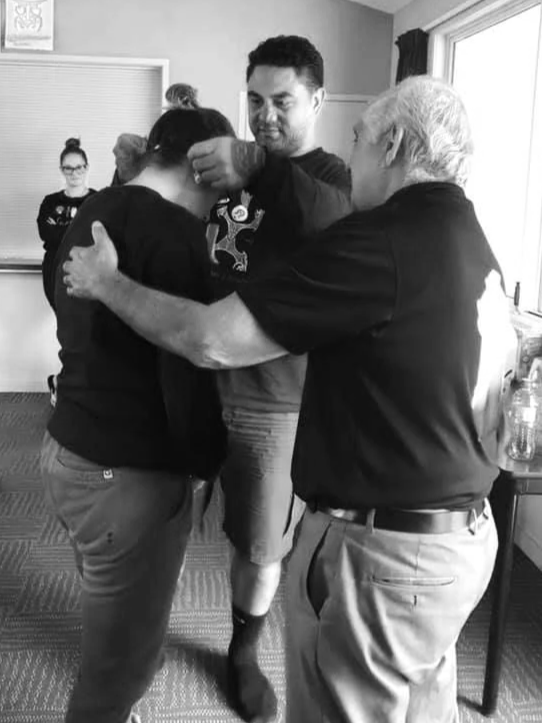
Pictured with Matua Wereta and taku darling George Kingi
This picture was a humbling moment, receiving my taonga in recognition of services to Ngā Pou Mana, Tangata Whenua Allied Health. Loading this pic up also made me feel weird, im like what are you trying to show here, it was really about how moving this moment was and will stay with me for life and to have the blessings of Matua the most honourable, humble man will stay in my heart.
Nā Teah