TĀNGATA TIRITI RESEARCH
FEBRUARY 2026 by RACHEL JANE LIEBERT
Drawing on our experiences in TTP, including our experimentation with guesting as a decolonial practice, in this post I (as the Pākehā lead) think/feel/imagine how Te Tiriti can be a guide for Tāngata Tiriti doing research with Tāngata Tiriti. It is not intended as a solution or a model to be universally ‘applied’ across all contexts (a colonial gesture!). It is an offering from what we have been learning so far. And it is a draft, as always. I would very much value any feedback from people who share our commitments to decolonisation.
Research has always been a tool of both colonial violence and decolonial movement. Kaupapa Māori researchers know this well – they continue to lead the world in Indigenous and decolonising methodologies – refusing the erasure of Māori ways of knowing/being/relating in not just what they study, but how.
It’s no surprise then, that Indigenous and decolonising research is under attack from fascist forces here in Aotearoa – echoing the fascist forces in US-Israel. As Ani Mikaere said in her 2023 address to Tiriti-based Futures, while these settler colonial governments are currently “baring their teeth”, genocide has always been “the bedrock” of settler colonialism.
Research continues to be one of the fighting grounds of and against the ongoing attempted genocide of Indigenous peoples.
And so, amidst both escalating attacks from US-Israel-New Zealand and our annual festival to reiterate the signing of Te Tiriti o Waitangi, we in TTP come to the end of our 3-year funding from the UK – the germ of today’s settler colonial violence. And we shift into a shape that is instead rooted in Aotearoa and thus in land that is both stolen and a powerful sovereign earth-mama.
Where and how do we stand on this land as white settler researchers?
We stand from and with Te Tiriti.
It is striking to me how quickly I answer this question. Contrary to what the settler colonial (mind)state would like us to think and feel, decolonisation does not need to be complicated in Aotearoa.
As pointed out in both Matike Mai and Critical Treaty Analysis, we do not need to fight over the Crown’s ‘treaty principles’, which divert and distort our decolonial attention toward the English, invalid, colonising, genocidal version of Te Tiriti. We simply need to return to the Indigenous text of Te Tiriti (the only valid text according to international law) and trust the 500+ rangatira Māori who signed it to guide not just what we study, but how.
Te Tiriti is not only a guide for researchers who are working directly with Māori. As white settlers we are Tāngata Tiriti – Te Tiriti is the conditions by which we are here, the place from which we stand, our turanga waewae. And, even when we are only working with other Tāngata Tiriti, we are still researching on Māori land.
Tāngata Tiriti are always in relationship with Māori. Te Tiriti is always relevant.
So what might this look like in practice? Below are some ideas from our experience with methodology in TTP over the past three years.
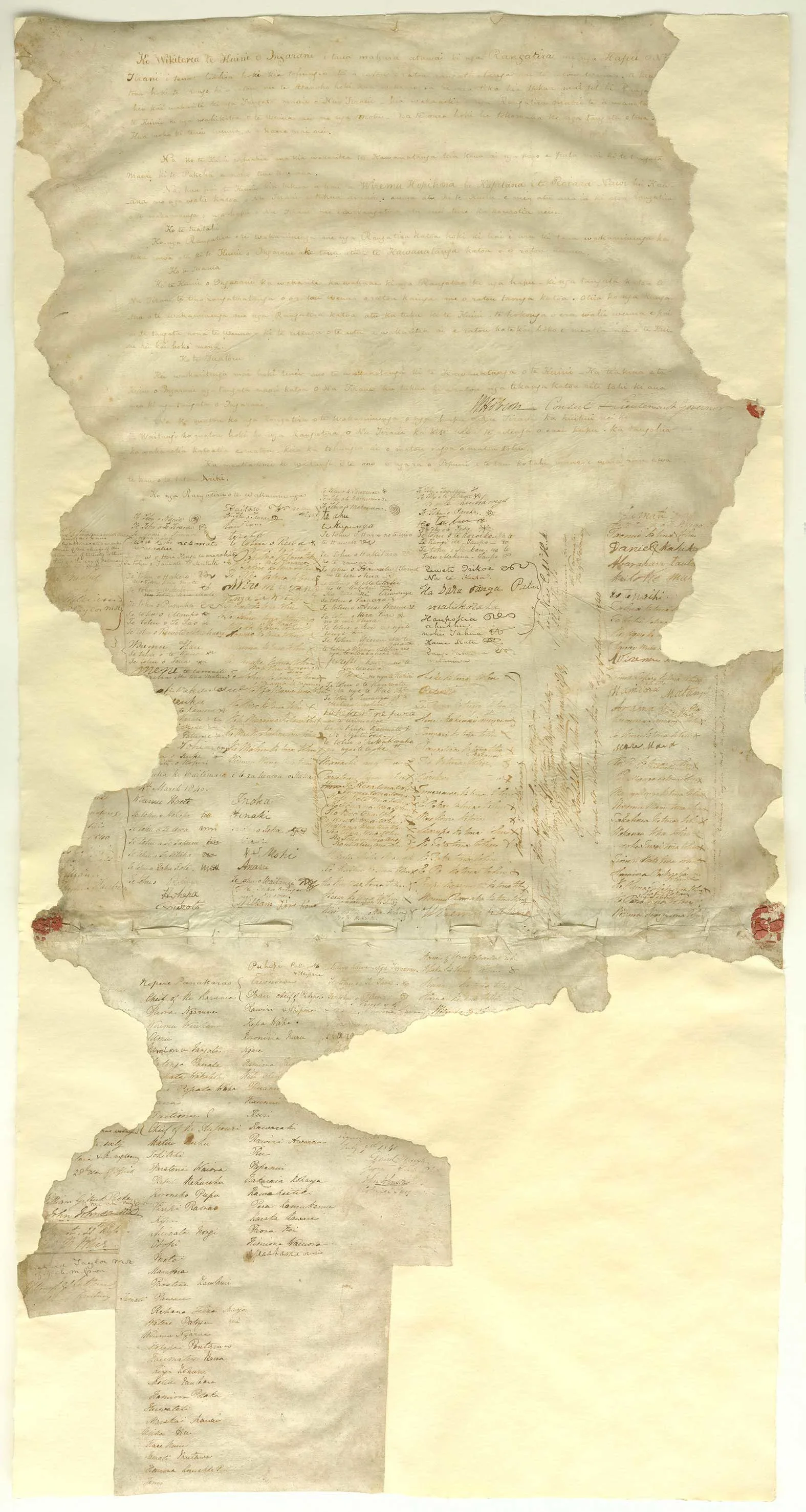
Te Tiriti o Waitangi - found in the basement of government buildings in 1907 - destroyed by rats. This post is based on translations of this text by Mutu (2010).
I: Kawanatanga: Is our research enacting our response-ability as Tāngata Tiriti?
As guests, we have tried to make sure that we and our fellow guests are respecting our hosts, including by cleaning up after ourselves. As researchers this could mean, for example–
- Building community through our data collection, analysis and dissemination, including the use of embodied, creative and collective methods where possible, so that we have the relationships necessary for being response-able together - that is, our collective ‘ability to respond’ to the obligations/opportunities of Te Tiriti
- Preparing each other to move into right relationship with Māori – here we follow Professor Moana Jackson’s words on Te Tiriti as pōwhiri, which includes the requirement that guests acknowledge the mana of not just Māori but also of ourselves – opening a place for ancestral methods of data collection, analysis and dissemination
- Reflexively attending to and intervening on our own and each other’s complicity in settler colonial violence during the entire research process, remembering that one of the tools of settler colonialism is the production of ignorance about settler colonialism
- Wherever possible, collecting, analysing and disseminating data in ways that contribute to decolonising movements, for example by considering in what ways the research could be used to challenge colonialism in our communities
II: Tino rangatiratanga: Is our research (not dis)honouring* the sovereignty of Māori and whenua?
As guests, we have tried to respect our hosts including by giving them space to do what they need to do. As researchers this could mean, for example–
- Acknowledging atua Māori during data collection, analysis and dissemination, including by attuning to elemental, lunar and seasonal happenings, practicing modes of listening to non-humans and respecting kai
- Learning local history, ngā pūrākau and iwi/hapū concerns and aspirations of the area in which we are researching through publicly available materials and other opportunities as they are offered
- Ensuring our entire research process (aim, question and design as well as data collection, analysis and dissemination) is welcoming to – but not entitled to or demanding of – Māori input, including by publicly documenting our research process
- Carefully searching for, including and acknowledging related Māori scholarship
- Nurturing opportunities to build and be in right relationship with local iwi/hapū, including through participating (and trying to be a good guest…) in Indigenous-led gatherings and events that are open to the public
- Trying to make sure our data collection, analysis and dissemination are not breaching local tikanga – this requires actively embracing opportunities to learn local tikanga and actively ‘listening out’ for the effects of our research process (regardless of intention), which itself requires an ongoing humility and readiness to fail and try again, and again
III: Ōritetanga: Is our research reciprocating to Māori and whenua?
As guests, we have tried to share what we bring (and we always bring something). As researchers this could mean, for example:
- Folding care for the land on/with which we are researching into data collection, analysis and dissemination
- Ensuring our entire research process (aim, question and design as well as data collection, analysis and dissemination) is welcoming to – but not entitled to or demanding of – Māori participation, including by looking out for opportunities to support the production of Māori research and scholarship
- Wherever possible, collecting, analysing and disseminating data in ways that contribute to Indigenous-led movements, including consideration of how our research could be used to strengthen our community’s solidarity with local iwi/hapū – this requires learning about Indigenous-led movements through public materials and events
- Sharing learnings throughout the process using diverse, multimodal forms
*‘Not dishonouring’ was an offering to Te Rōpū Pākehā from Tehseen Noorani (now co-leading our TOC collective) – so far we have found that this framing frees both Tāngata Tiriti and Tāngata Whenua from our anxious need for approval, lessens risks of appropriation of tikanga/matauranga and opens a space for Tāngata Tiriti to be less dependent on/extractive of Māori labour as well as more experimental and creative.