GUESTING
JANUARY 2026 BY RACHEL JANE LIEBERT
Following is an extract from an academic article that Te Rōpū Pākehā is drafting about guesting as decolonial practice. However, this isn’t a Doctrine of Discovery – there is no terra nullius and Indigenous worlds are already here, still here despite our coloniser efforts. As described by TTP’s Indigenous-lead, Dr Teah Carlson, what follows is very “ordinary” – the literal translation of ‘Māori’. Instead of ‘findings’, we therefore offer the ideas that follow as some of the droppings of our white settler collective – humble wanderings and wonderings that have been metabolised through our lively project and that, if received and wrapped in the right conditions, could perhaps help fertilise the soil for Matike Mai – or at least leave a trail to show where we have been, what we have tried.
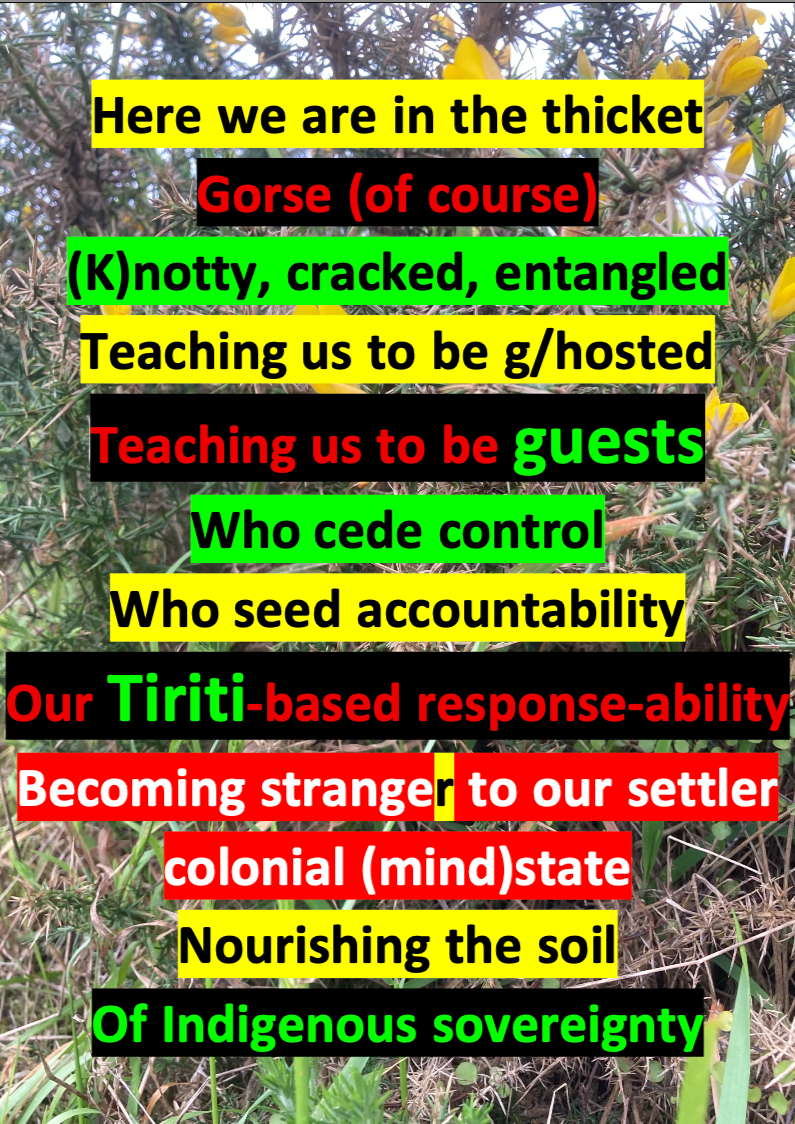
An experimental ‘dropping’ from The Pākehā Collective of The Tīpuna Project on guesting as decolonial practice. The piece braids the wisdom of gorse (as also noted by Pākehā elder Heather Came), the shared etymological root of host, guest and stranger (ghos-ti-) and whakaaro on manaakitanga from Matike Mai authors, Moana Jackson and Margaret Mutu.
host (n.): "person who receives guests," especially for pay, late 13c., from Old French oste, hoste "guest, host, hostess, landlord" (12c., Modern French hôte), from Latin hospitem (nominative hospes) "guest, stranger, sojourner, visitor (hence also 'foreigner')," also "host; one bound by ties of hospitality." This appears to be from PIE *ghos-pot-, a compound meaning "guest-master" (compare Old Church Slavonic gospodi "lord, master," literally "lord of strangers"), from the roots *ghos-ti- "stranger, guest, host" and *poti- "powerful; lord." The etymological notion is of someone "with whom one has reciprocal duties of hospitality" [Watkins].
guest (n.): Old English gæst, giest (Anglian gest) "an accidental guest, a chance comer, a stranger," from Proto-Germanic *gastiz (source also of Old Frisian jest, Dutch gast, German Gast, Gothic gasts "guest," originally "stranger"), from PIE root *ghos-ti-"stranger, guest, host" (source also of Latin hostis, in earlier use "a stranger," in classical use "an enemy"); the root sense, according to Watkins, probably is "someone with whom one has reciprocal duties of hospitality."
Our experiences in TTP suggest that, for white settler peoples, communing with ancestors requires being both ghosted by (k)nots of what we have done, do and could do – holding us to account; and hosted by the more-than-human – irrupting via cracks that have us cede control. What kind of response-ability emerges from this obliging, uncontrollable thicket?
This question vibrates with Bayo Akomolafe’s notion of ‘post-activism’, when ‘our’ agency is not our’s alone, but distributed through everyone and everything around us – entangled, (k)notty, cracked. In post-humanism, such entanglement is often implied as an issue, as something that takes away agency. It is as though we (researchers, activists) do not know ourselves outside of this – we are lost, in the dark.
However elsewhere TTP’s co-leads have written how darkness protects our project within a context of (En)light(ened) pollution. For us in the white settler collective, darkness guides our ability to respond to settler colonialism. Locating us in the cracks of Knowing Knowledge, Knower, darkness forces us to accept that we are unable to fully see where we are going – to Know what a decolonised Pākehā or a decolonised Aotearoa looks like – and therefore need all our senses to feel the way. Moving slowly, carefully – hesitating, stumbling, trying again – we are less able to pursue urgency and mastery, and are more protected from our colonial leanings toward dualisms, reductionism, solutions, perfectionism, individualism, cogni-centrism, anthropomorphism… Instead edges are blurred, things are merged, shift shape, shapeshift, contradictions cohabitate.
All of which are said to be necessary conditions for sheltering the more-than-human. Being in the dark, entangled does not take away our agency so much as invite us into another, more relational kind. In TTP, this entanglement has meant being ghosted by (k)nots and being hosted by cracks – an overarching experience of being g/hosted that positions us as guests. Could, then, guesting – an agency that seems especially pertinent for white settler peoples in a settler colonial state – offer guidance for how we can be response/able in the thicket – ceding control but not accountability?
Prof. Margaret Mutu (Ngāti Kahu, Te Rarawa, Ngāti Whātua, Scottish) – a co-author of Matike Mai – writes of Te Tiriti o Waitangi (TToW) as an act of manaaki – to refuse TToW is to take the authority and mana of hosting away from Tangata Whenua. In a 2024 interview she describes this further:
That responsibility [of Tangata Whenua today] includes manaakitanga – caring for everyone. “We invited people in here, we are responsible for them,” says Margaret, referring to te Tiriti o Waitangi... “But when you have dispossessed us […], we can’t do our job properly.”
When talking about the process of developing Matike Mai she continues:
… people “never talked about the models we ended up talking about, they talked about the values to uphold this country….. they would say ‘as long as you get those values right, as long as you include everybody, so long as you make sure everybody is safe and looked after, the rest of it will flow.’ […] That’s our responsibility [as Māori] to manaaki everyone so they can be proud of who they are.”
The definitions used to open this post suggest that ‘host’ and ‘guest’ share an etymological ancestor: ghos-ti- – the host is entangled within the guest, and the guest is entangled within the host – as can be seen in the definition of both as “someone with whom one has reciprocal duties of hospitality”. Thus if, in Mutu’s words, it is the responsibility of Māori to host, is it not therefore also the responsibility of Pākehā to guest?
True to spectral form, while not named as a descendent of host’s and guest’s etymological ancestor, ‘ghost’ clearly hovers close-by (failing to hide beside the hyphen and the eye). And there is another descendent hovering here: stranger. Is the host-guest relationship accompanied not just by the ghosts but also by the strange – the more-than-human, the awkward?
If we move more deeply into guesting, might we able to become strange(r) to settler colonialism?