October 2026, BY RACHEL JANE LIEBERT
Tehseen Noorani and I are in the middle of writing an experimental piece on the decolonial potential of guesting for tauiwi (settler peoples) in Aotearoa. We see guesting as a means to reciprocate the manaakitanga that moves through Indigenous accounts of Te Tiriti and its realisation in Matike Mai. Indeed we see it as a means to honour Te Tiriti as a ‘sacred covenant’ between not just rangatira Māori and the British Crown but also between both tīpuna Māori and our ancestors - human and non-human.
And we argue that guesting requires vigilance and care given its ontological and etymological tendencies to become parasitic, hold hosts hostage, be ghosted…
Below is my attempt to listen to gorse - as one of our oldest settler ancestors - about these potentials. The piece began as spoken words for a recent pop-up of our Something Awkward experimental public lecture series.
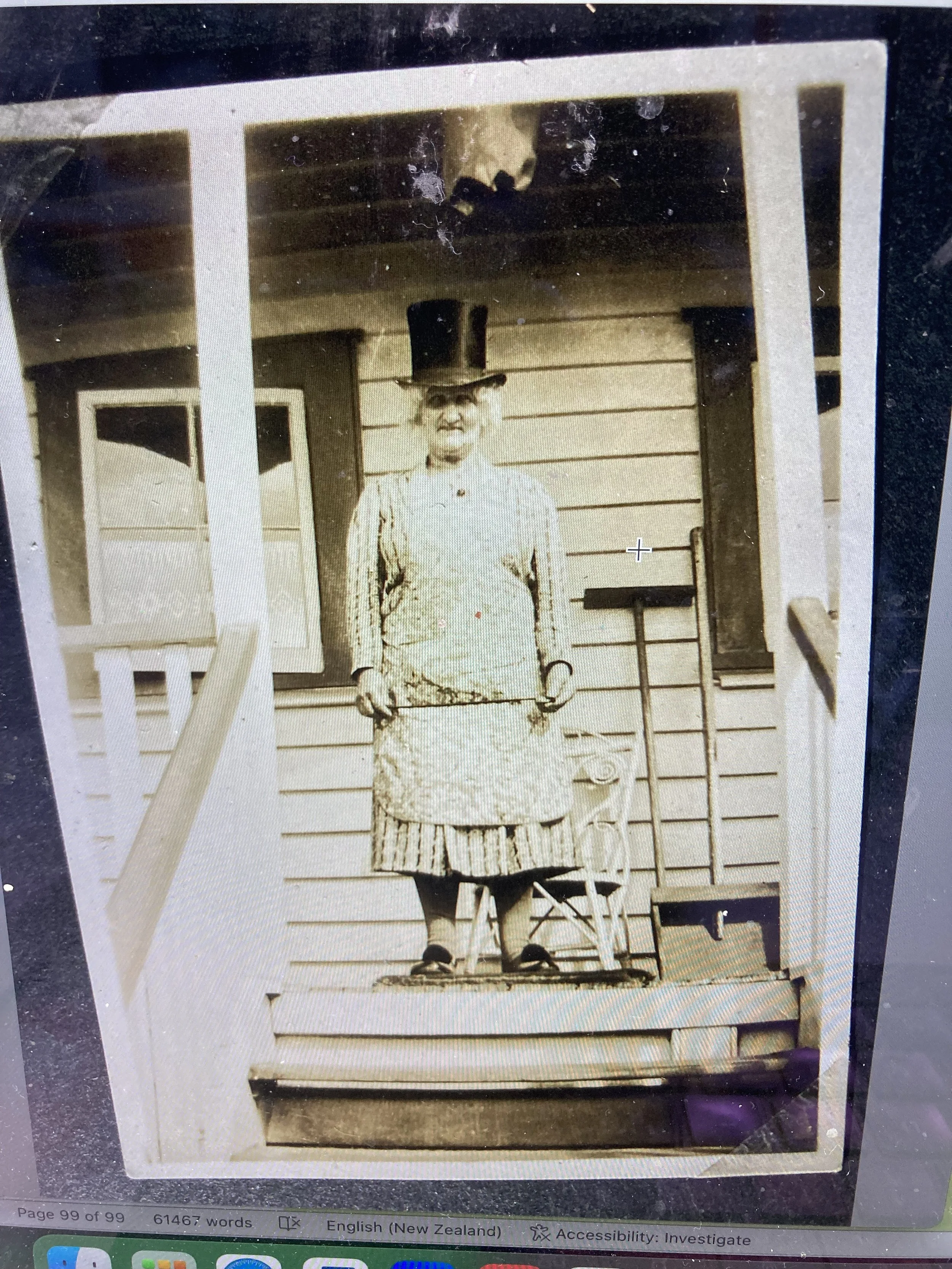
Grannie McCarthy, born to parents who immigrated to Aotearoa from Gaelic Ireland - my great great grandmother and first Pākehā ancestor. This photo, and Grannie herself, have been so generative for me because of their trickster quality - is she a guest, a host, a ghost?
Gorse is one of our oldest settler ancestors here in Aotearoa – brought over from Western Europe in the early 1800s as a hedge species.
A hedge species.
A fence-maker, land-breaker, land-taker.
Enclosing.
Stealing.
Spreading.
Gorse is a supplant.
Brought over by the settler colonial project to assist in their attempts to replace Māori authority – gorse was on a mission to steal land.
Eventually smothering large areas of the country – contributing to this settler colonial state, this state of breathlessness.
Listen to its thorny scratches – like the spikey little claws of rats, in the basement of NZ government buildings one hundred years after gorse arrived, destroying Te Tiriti o Waitangi…
In the 1850s, a decade after the signing of Te Tiriti, the New Zealand government introduced legislation requiring that Crown land should be fenced using gorse – making seeds and young plants abundantly available for sale.
Fence-maker, land-breaker, land-taker, money-maker.
I feel this thorny history in my own bones. My human settler ancestors here in Aotearoa were also brought over from Western Europe to steal land. To be supplants. For don’t forget that settler colonialism is called settler colonialism. The main weapon of this state is: settlers: our Pākehā ancestors.
Take our own colonial militia – the NZ Forest Rangers – explicitly paid in large quantities of rum to help them numb, to help them solder those feelings, sold(i)er those feelings – and paid with stolen land: After his parasitic contribution to the massacres at Rangiaowhia and Ōrakau, my great great great grandfather was given 50 acres of whenua Māori and a plot in the Waikato at Harapipi – a small planned settlement for ex-militia, deliberately placed to supplant Māori and block the resistance movements. Effectively eating Māori out of their own home.
Listen to its thorny scratches – like the spikey shards of glass sticking into my inherited arthritic bones – my ko-iwi, my tribe, my ancestors – screaming out that they have a painful story to tell…
Heinrich Pohlen, my militia ancestor in the Forest Rangers, was rewarded for murdering whānau Māori, but when he then murdered his Forest Ranger neighbour over a boundary dispute in Harapipi, he was incarcerated in a psychiatric asylum. His diagnosis? Monomania = a pathological obsession in one thing. His one thing? Up until his death, my ancestor spent his years down on his hands and knees in his concrete cell, clutching his war medal and his rosary beads in one hand, and using the other to maniacally scratch out the boundary of ‘his’ land over and over again.
My militia ancestor was literally diagnosed with a colonial dis-ease – a pathological obsession with owning land.
Listen to its thorny scratches – like the finger nails of the Crown as it picks apart our colonial history, trying to make us think it didn’t happen, it isn’t happening…
Maybe this is why our Pākehā mentor in anti-racism, Heather Came, has long argued that – while we, Pākeha, may want to frolick in the ngahere, in Te Ao Māori, our job as Pākehā is to (quote) “clear the gorse”[1]. To clean up the mess that we made, to stop ongoing settler violence, so that Māori authority, with the land as its sacred source, can breathe freely again.
And yet, keep listening, do you hear anything else? Any whispers of something other-wise?
On their website, Massey University’s centre for Plant Science Research describes gorse as follows:
“Gorse is considered by many to be New Zealand’s worst scrub weed. It was originally introduced in early 1800s to New Zealand as a hedge species, but now occupies large areas of hill-country, reducing the area available for grazing by livestock on pasture land. It also causes severe competition with young forest trees and makes access to forests difficult for pruning and thinning operations.”
Who exactly is gorse a problem for? The state of “New Zealand”, “livestock”, “pasture land”, young “forest” trees, “pruning and thinning operations”… What if gorse doesn’t just commit settler colonial violence, what if it also interfereswith it? What if our job as Pākehā isn’t to clear the gorse so much as listen to it? What can we learn from gorse – our oldest settler ancestor – about being Tāngata Tiriti, about being a thorn in the side of the settler colonial state?
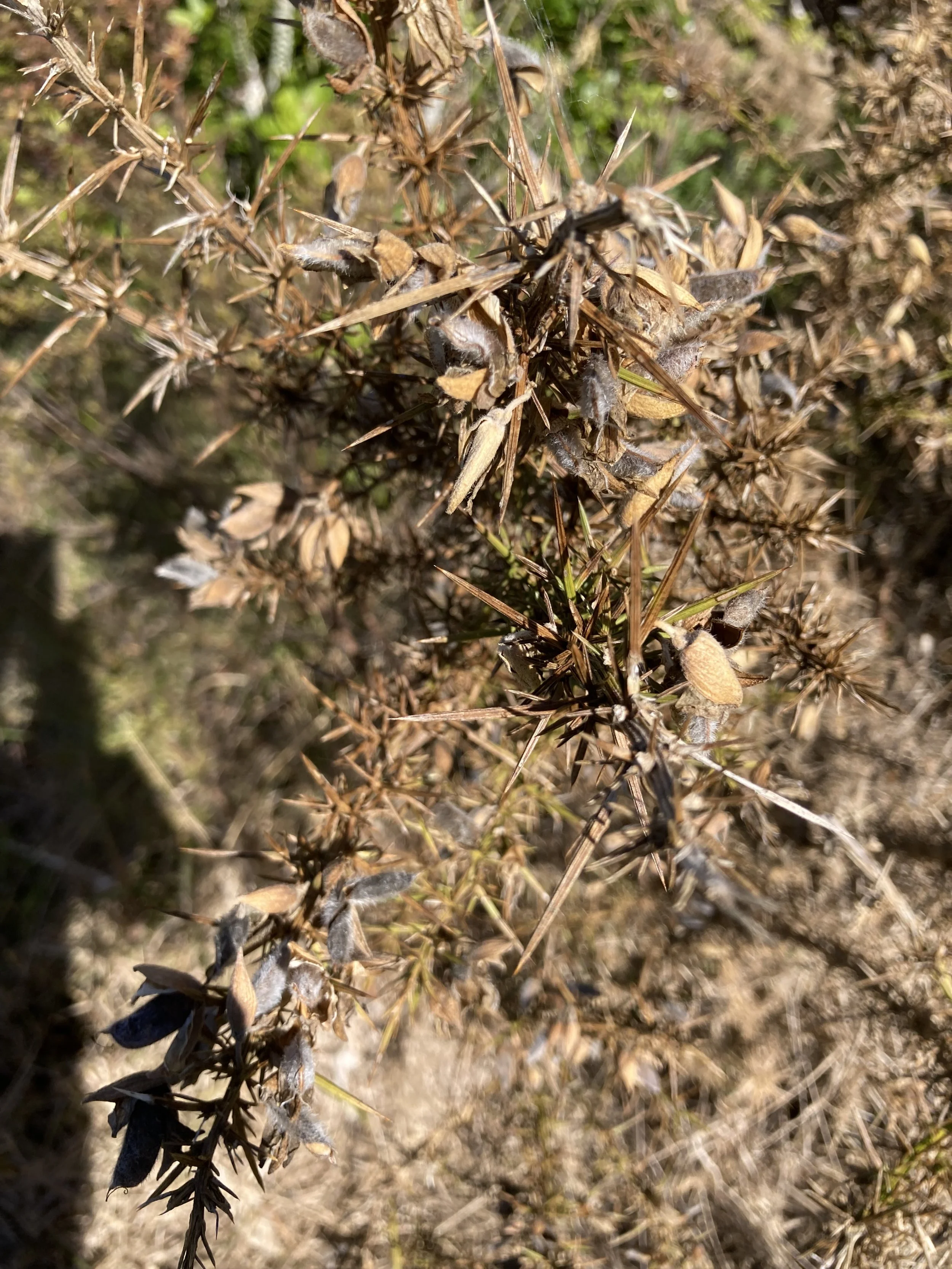
I went to Kororareka in August with our oldest kid. We had to go and care for my dad who lives there (a direct descendent of Heinrich Pohlen), and decided to harvest some gorse flowers grown straight from the land that it first enclosed, straight from the land where the need for Te Tiriti was seeded.
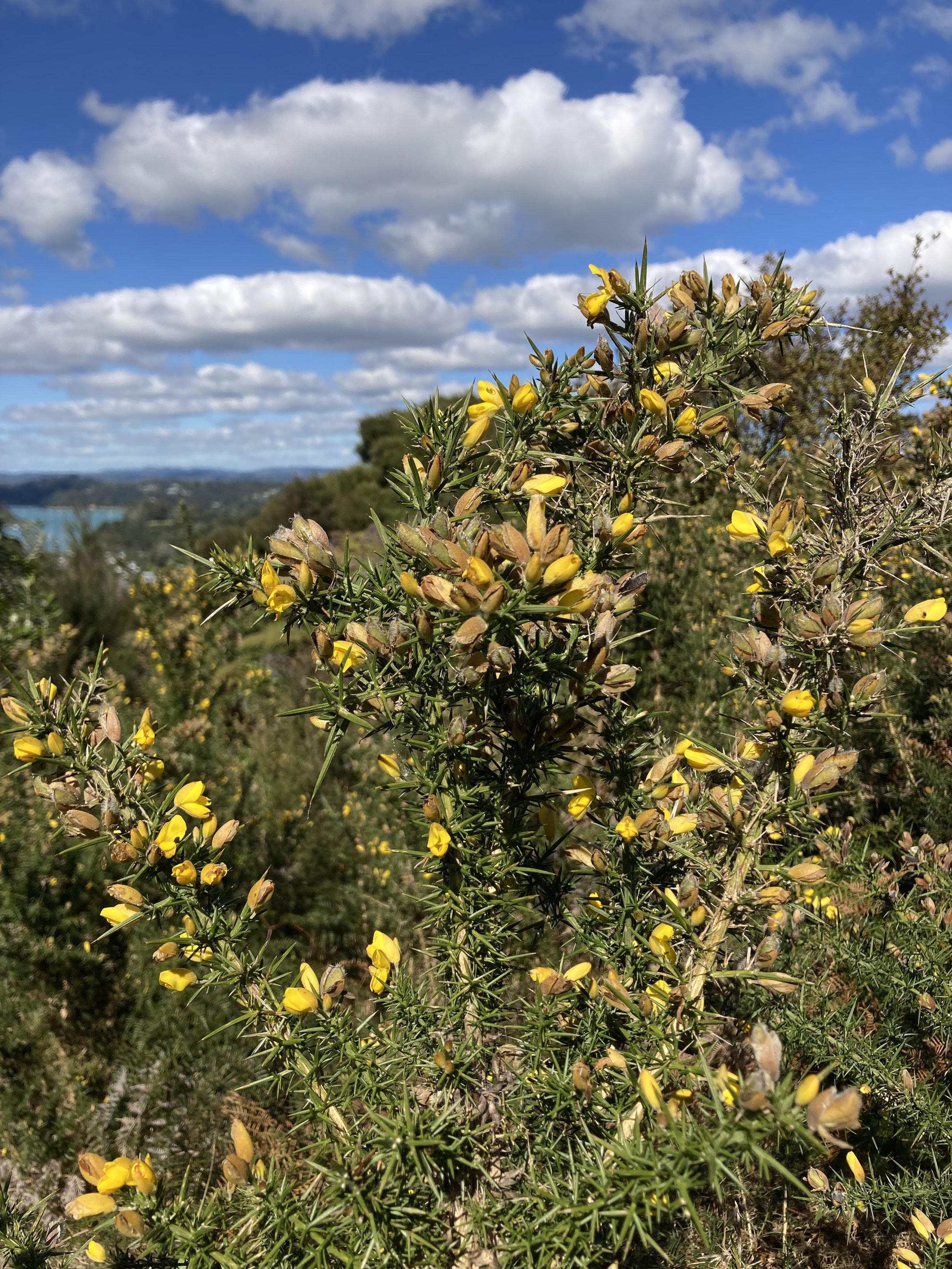
I knew of gorse’s setter colonial past, but I had also recently heard that it is more-than-this, more-than-colonial. That, by moving nitrogen from the air to the soil, offering shade and using its thorns to keep predators (including farmers) away, gorse also had been quietly making space for native seedlings to grow. Gorse has a counter-colonial story to tell, too.
Listen to its thorny scratches…
My uncle (Dad’s brother) called when I was in the thick of it, the thicket – by coincidence he too had been harvesting gorse so my aunty could colour some soap. Taken by the synchronicity, I decided to do the same – to use gorse to colour each of the three articles of Te Tiriti, as a way to hear its ancestral advice on how we can contribute to Matike Mai, to finally realise the promise of Te Tiriti.
A couple of weeks later, our kid and I also collected some fallen petals from a kowhai tree growing in the Waikato. Like gorse, kowhai is a legume, also flowering yellow. Unlike gorse, it is native. Indeed it was flowering when the missionaries first arrived Aotearoa[2]. This particular kowhai was growing from the whenua of a marae where we were guests for a friend’s mata ora ceremony.[RL1] Our friend is Ngāti Maniapoto – a descendent of the survivors of the Forest Rangers’ massacres. The waiata sung by haukainga in the mihi whakatau was E Pa to Hau – a lament written for survivors.
Their kids and our kids – survivor descendants and soldier descendants – played together all day, ultimately gravitating toward this kowhai, which they proceeded to together make their “home”.
If the gorse from Kororareke was growing directly from the land that our non-human ancestor first enclosed, straight from the land where the need for Te Tiriti was seeded; this kowhai was growing directly from the land that our human ancestor helped to steal, ripping Te Tiriti out from its roots.
I added the kowhai petals to our gorse dye, so that their native authority – on guesting, on betrayal, on theft, on reparative home-making – could also be listened to for advice on how to be good guests in a settler colonial state, given our violent history.
Effectively: how to be Tāngata Tiriti, now.
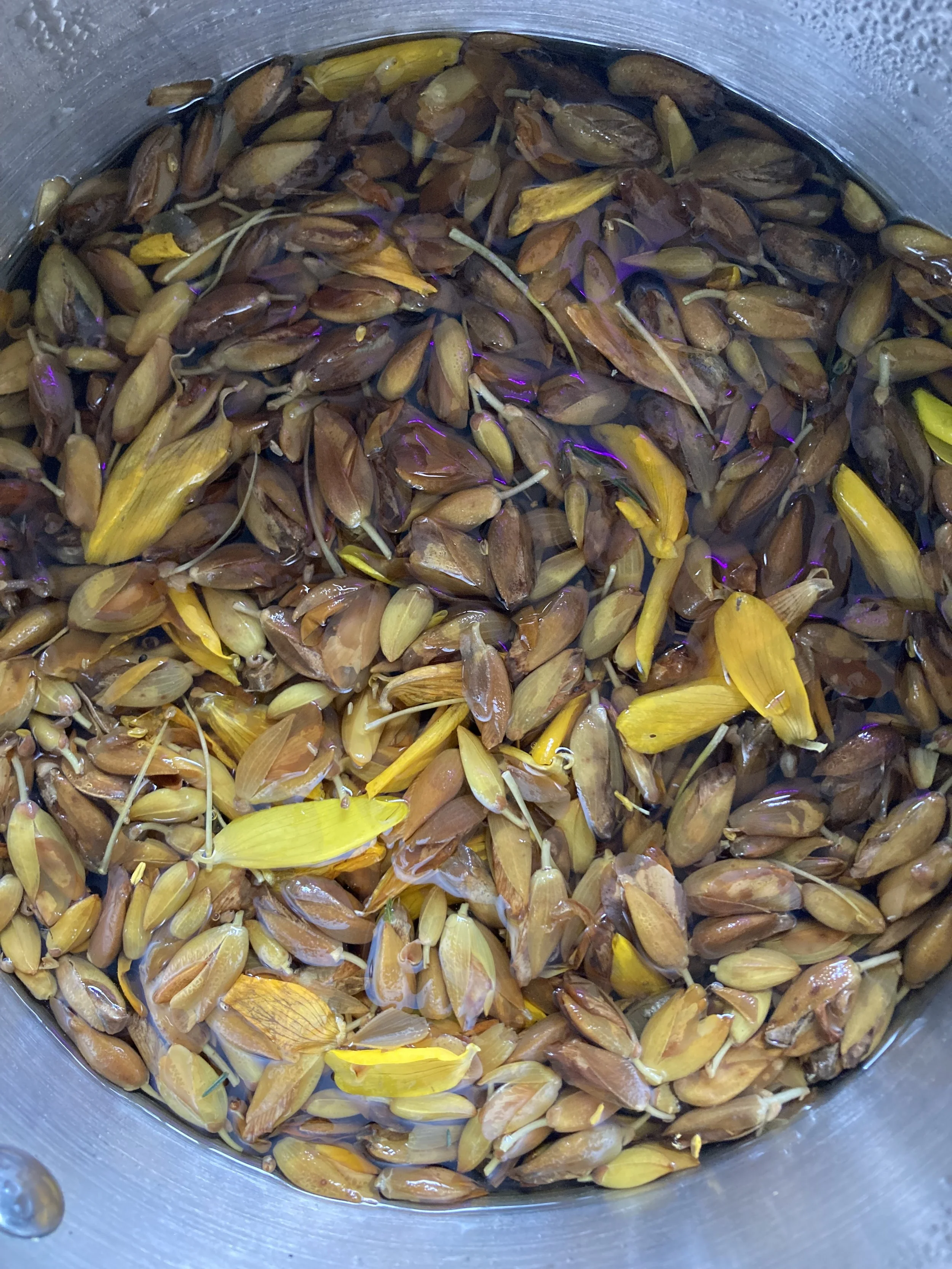
I undertook a drawing ritual.:
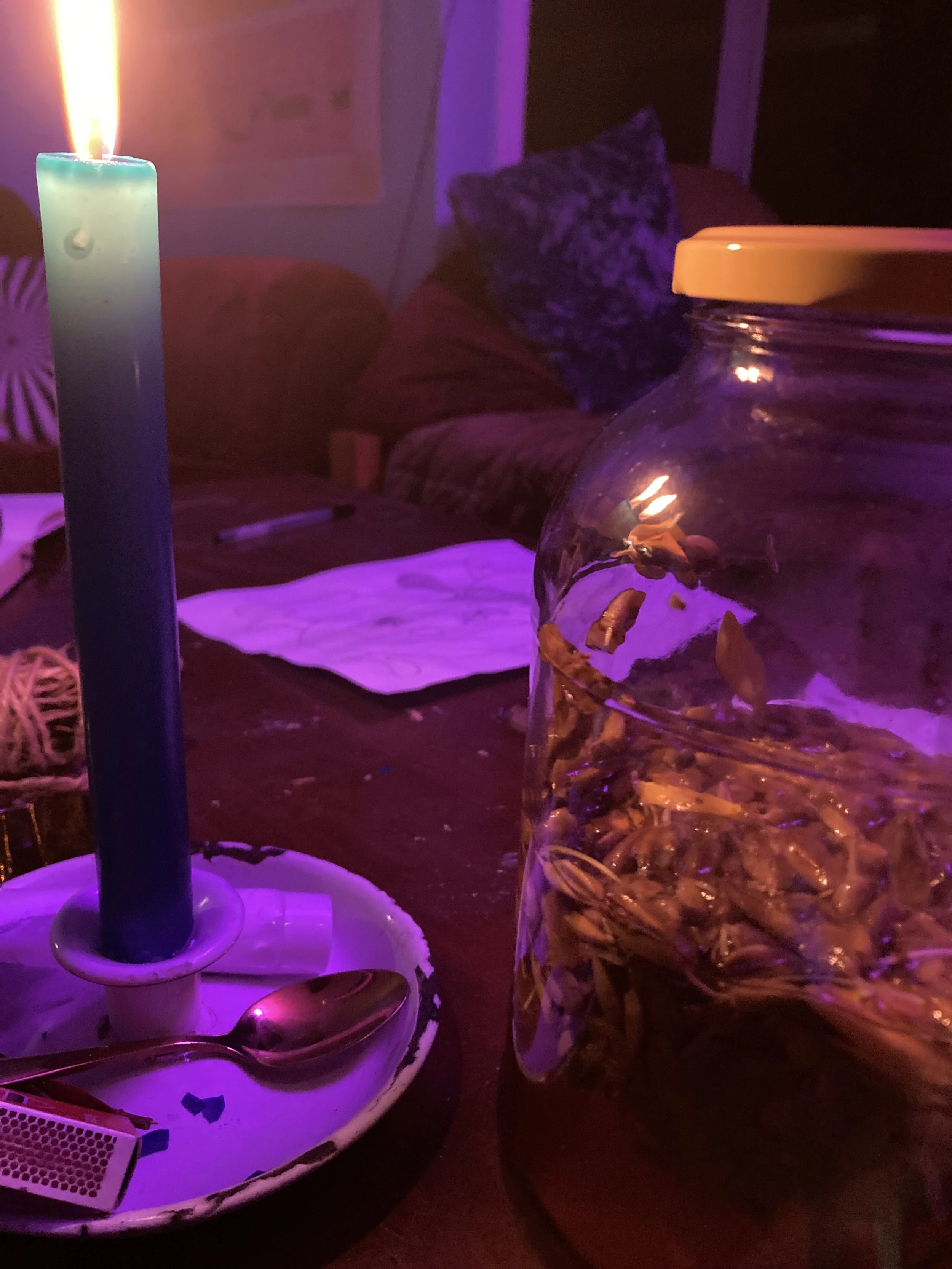
And to my surprise I instantly met this ancestor:
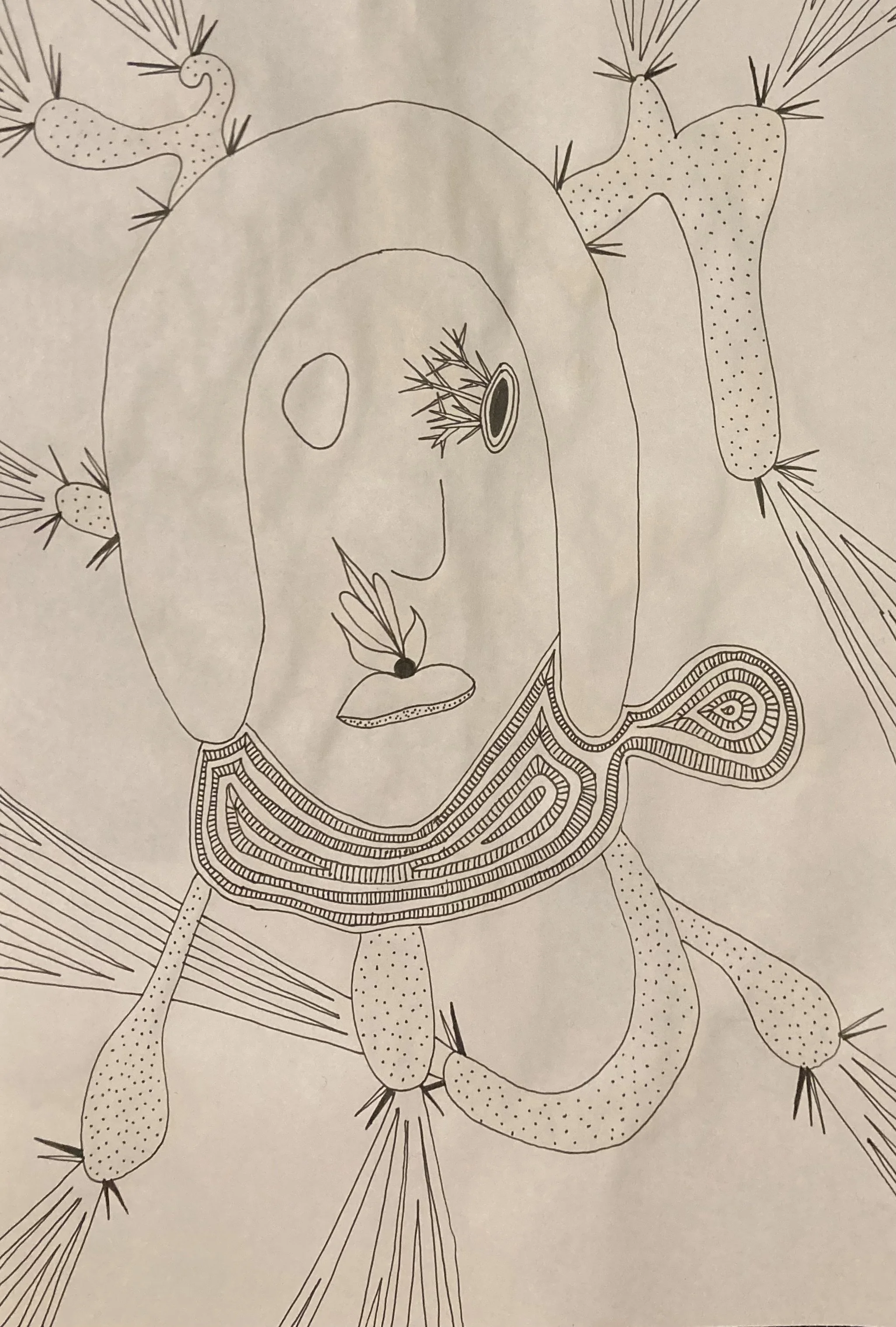
Adam Glasgow – another great, great, great grandfather, but on my mum’s side this time. A missionary who fled the potato famine in Ireland – created by England’s first attempt at colonisation. Adam Glasgow and his wife (my great great great grandmother, whose name I carry) went to preach in Gujarat, India[5][TN3] , giving birth to my great great grandfather before moving to Te Wai Pounamu – preaching now on Kai Tahu land, a full-blown global agent of the same settler colonial state that first displaced him. Both colonised and coloniser.
Adam Glasgow arrived when I was asking gorse about Article 3 of TToW – asking us to live here with reciprocity. He appeared sprouting roots, and all I could hear was,
Āki! Āki! Āki!
Āki! Āki! Āki!
Āki! Āki! Āki!
Not, ‘Āke, ake, ake!’ – the famous war-cry of Indigenous rangatira Rewi Maniapoto as my Forest Ranger ancestor and his militia comrades attacked Ōrakau.
Āki! Āki! Āki!
Urging me on, it felt as though this ancestor (who I had never met before) was telling me that some of my ancestors were fighting with me against colonisation, and that another way of being here was possible.
Reciprocate! Reciprocate! Reciprocate!
Give back! Give back! Give back!
Listen to its thorny scratches…
Gorse is susceptible to transformation. Once it has provided the protection and nutrients for native seedlings to grow, it composts in their shade – humbly returning itself to the ground – from guest to host and back again. And in the summer, when it gets dry, at its finest brownest, it catches and spreads fire – burning itself down, returning its excesses to the ground, offering nutrients. Is gorse suggesting that Matike Mai – our movement for constitutional transformation – is asking of us, Pākehā, to do the same? To take responsibility for transforming ourselves? To become something else? A different kind of guest. One that does not take from the land, or take it; one that gives back to the land, that even gives it back.
Āki! Āki! Āki!
What a war-cry for Tāngata Tiriti. Calling on us to not be supplants, but transplants. Transplants. Being both/and. Bothfrom our lands there and from the lands here. Growing roots, both nourished and nourishing, reciprocating, giving back.
And giving it back. One month after this ritual, my Gaelic ancestors gently told me off for not asking the proper permission when taking the kowhai leaves used in the dye. They told me to take my kids and together return the entire dye to the base of the tree with love, reminding me that to be a good descendant includes accepting when we have done something wrong and doing something about it. Being response-able. Article 1.
Listening to gorse has helped me to know that, as I try to embody being Tangata Tiriti, I am not alone. My gorse, Glasgow and Gaelic ancestors are urging me on. Honouring TToW is perhaps how we, Tāngata Tiriti, can locate and state our ‘mana’ – described by Mutu (2014) as the “paramount power” derived collectively from one’s ancestors (including the land herself as the mother of all ancestors); the statement of which is offered by Jackson (2019) as the first step for settler guests to create right relationship with Indigenous hosts. As a sacred covenant, what if TToW is an agreement between not just rangatira Māori and the British Crown, but between their ancestors and our ancestors – human and non-human? If so, then to honour it is to also restore honour to our family lines. Moving backward through our ancestors, moving forward through our descendants, moving awkward through our more-than-human-ness. Becoming both guests to our hosts and stranger to our settler colonial (mind)state – breathing the spirit of TToW.
Listen to its thorny scratches. Can you hear us?