GATHERING AT THE GATE
APRIL 2026 BY RACHEL JANE LIEBERT
Gathering at the Gate (GatG - “Gat-Jee”) is an 8-week online popular education program in Aotearoa that aims to contribute to decolonisation by facilitating ancestral recovery processes for those of us who descend from white settler peoples. The course was designed and facilitated by two of TTP’s Pākehā co-researchers – Wren Mabin and Dani Pickering – as well as Elli Yates and Erin Thomas – all white settler femmes with longstanding decolonial practices in Aotearoa. Since 2023, over 100 people have gone through GatG – predominantly Pākehā from Aotearoa but also white settlers from Whenua Moemoea, Azania and Turtle Island, as well as a handful of people who additionally had whakapapa Māori or Asian ancestry. In 2024, as part of TTP, I had the privilege of leading a grassroots evaluation of the course – following are extracts from our draft report, which we hope to release in full by Matariki.
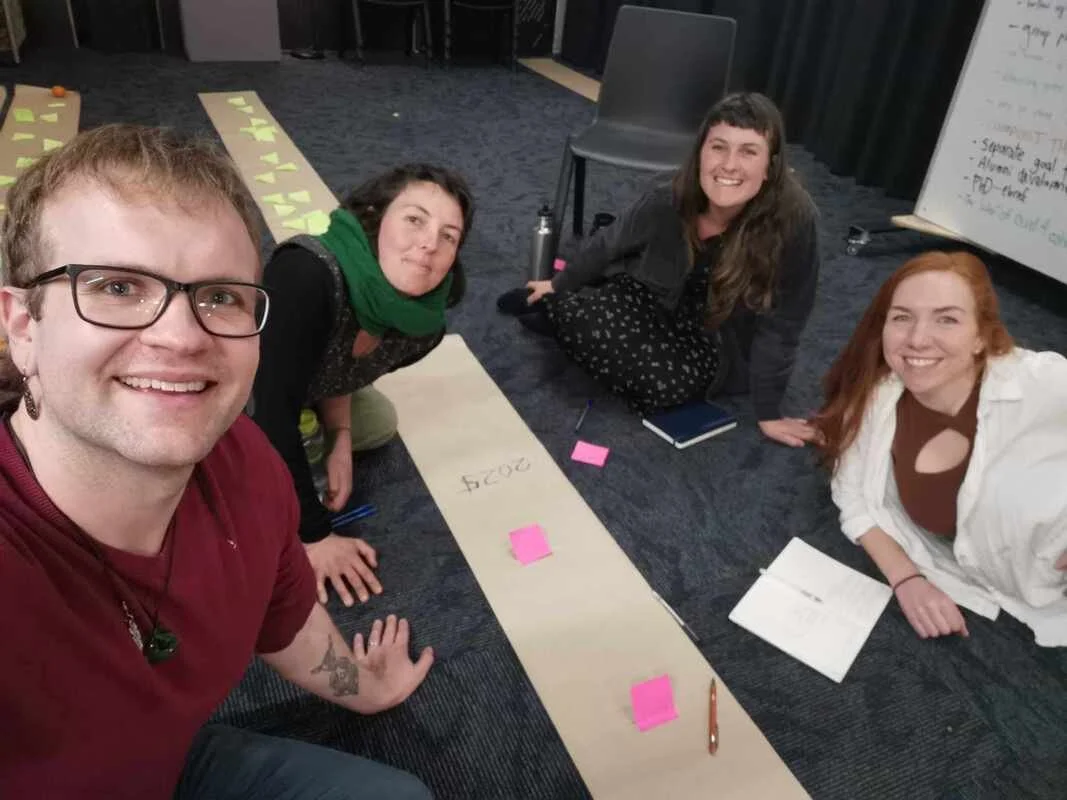
Dani, Wren, Elli and Erin - the founders of GatG.
For facilitators and participants, the effectiveness of GatG has been viscerally felt. This evaluation offers an analysis of this experience in order to identify seeds of decolonial potential in the GatG process. We hope to in-form[1] the continuation of the course as well as offer something useful for other activists and practitioners interested in the potential decoloniality of ancestral recovery for white settler peoples. This potential is approached through the guidance of Matike Mai – a nationwide, Indigenous-led movement to transform the country’s constitution in respect of Indigenous sovereignty, thereby fulfilling the promises of Te Tiriti o Waitangi. Given that Matike Mai requires Pākehā to both “fix up your whakapapa”[2]and return stolen land[3], the phrase ‘settler-colonial (mind)state’ has also been used throughout the report to interrupt the colonial distinction between mind and matter.
…..
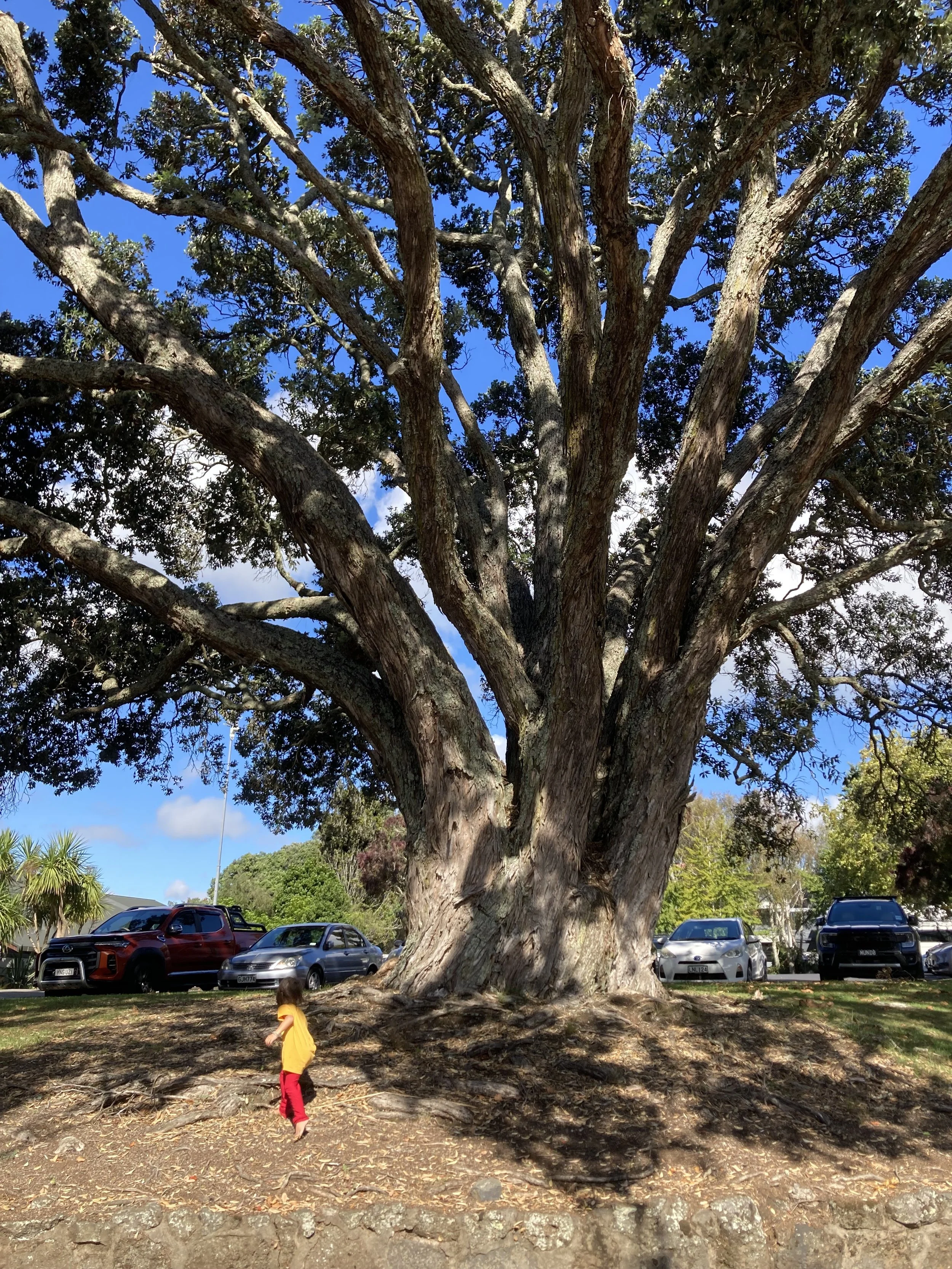
Photo of my oldest kid, then 4, who I took with me on a self-designed GatG ‘story-catching’ assignment to learn about the role of our militia ancestor in settler colonial violence. We experimented with listening to this large Pōhutukawa tree, which is all that remains of an Auckland asylum where our ancestor was incarcerated at the turn of the nineteenth century.
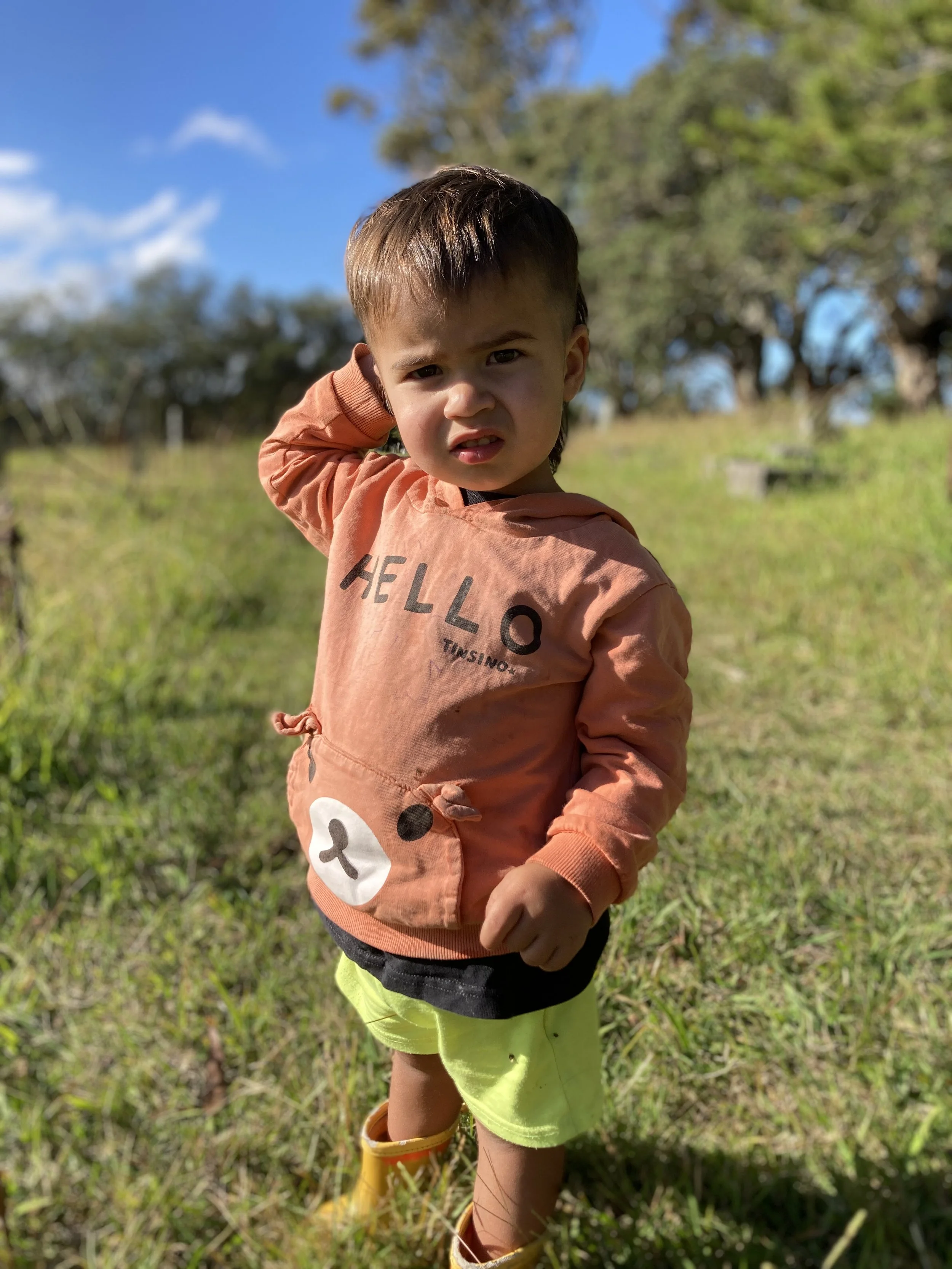
Photo of my youngest kid, then 2, who came with us on the above story-catching assignment. Here we are at the cemetery where our ancestor is buried. The assignment led to a reflection on how we talk to our children about our settler ancestors’ violence.
Grassroots: Methodology
This report is predominantly in-formed by my experience with TTP as well as an experimental approach to evaluations that I have been developing with Tehseen Noorani through our community-based praxis over the past decade[4]. Embedded within a ‘transformative paradigm’ that explicitly commits to social transformation and explicitly prioritises the expertise of the marginalised[5], grassroots evaluations additionally recognise, “the lively underground of struggles with which our evaluation partners are entangled, and within which there is a constant transfer of resources, knowledge, and energy”[6]. A grassroots evaluation thus aspires to social transformation by digging into evaluatees’ entanglement with social movements.
To do so, our process is driven by three interconnected values (all themselves inspired by the capacious qualities of the grassroots). First, rhizomatic accountability, which does not simply ‘include marginalised voices’ but allows this expertise to be dynamic and plural across time, space and bodies, thus orienting to relationality over essentialism. Second, dark reflexivity calls for evaluatees and evaluators to attend to our response/ability[7] regarding the structural issues at hand – requiring multisensory attunement and a commitment to unknowing (both challenging what and how we (think we) know, and a readiness to engage with issues less as problems to be solved and more as mysteries to engage[8]). Third, through more-than-human hosting we commit to also collaborating with non-human stakeholders by making evaluation spaces that shelter their liveliness rather than ignoring, extracting from or ‘capturing’ them – allowing them to affect our process in ways that disrupt the human-centrism of the colonial episteme and enable us to imagine other-wise[9].
As Tāngata Tiriti, when undertaking grassroots evaluations in settler-colonial contexts such as Aotearoa, this third value also extends to include practices of more-than-human guesting that decentre not simply the human but the settler – respecting the sovereignty of both whenua and Māori and thus He Whakaputanga. Moreover, with their explicit, ongoing attention to colonisation and decolonisation as well as relational and more-than-human ontologies, it is hoped that grassroots evaluations help to better align the transformative paradigm with Kaupapa Māori evaluation[10].
…..
Remembering also that colonialism thrives on separation and reductionism[11], rather than the vivisection required of standard qualitative analysis methods[12], we experimented with a holistic analytic approach that is driven by metaphor – inviting participants’ experiences into relationship with one another and the wider ecosphere while also retaining a kind of slipperiness that undermines colonial tendencies to extract and capture. Thus after collecting the data and immersing ourselves in participants’ words, Wren and I individually immersed ourselves in participants’ words and noted any nascent analytic insights, before talking with each other and seeing if any imagery felt conspicuous – e.g., it ‘stood’ or ‘jumped’ out or otherwise particularly called our attention.
In turn, our analytic method became guided by worms. As in the quote used to open this report, these creatures first surfaced through participants’ use of a cliché to describe the course as ‘opening a can of worms’. Resonant with notions that colonialism is the ‘worm-eaten roots’ of society[13] and that worms’ skills in aeration can teach us something about ‘re-turning’ oppressive histories[14], we understood worms as non-human experts in transforming settler-colonial (mind)states of breathlessness[15] so decided to see what would happen if we followed their lead.
In order to keep our analytic image as vibrant and dynamic as possible, as well as to honour the depth and nuance of participant experiences and reflections, we also have extensive illustrative quotes. These are presented together at the beginning of each sub-section, before putting them into conversation with worms and scholarship in order to expand their suggestions for decolonising the settler-colonial (mind)state. We end with a set of recommendations or castings (worm poo) – the particularly fertile offering made by worms to the land.
…..

Image of worms from the much-loved mara of Pākehā co-researcher, Sarah Hopkinson. Worms were the guiding image in our evaluation - participants found that GatG “opened a can of worms” that were then sheltered by the course, allowing them to compost our settler-colonial (mind)state.
Dark & most: A sheltered space
Participants spoke repeatedly of GatG’s rarity and how much we have been yearning for something like this. This ‘this’ was not just about the content. To be generative, the above worms were released and sheltered in a pedagogic space that was constantly trying to counter the tendencies of settler colonialism and, in particular, whiteness. The openness, experimentation and flexibility of the facilitators was central to the cultivation of such a space as they embodied the kaupapa in ways that encouraged us to not be seduced by colonial, white supremacist values such as hyper-rationality, perfectionism and urgency. In turn, protected from a superior, anthropomorphic sense of certainty and clarity, this pedagogic approach could also welcome more-than-human contributions to the learning space[16, 17]. Thus GatG became somewhat characterised by its inclusion of diverse expertise through participatory, imaginative practices of listening to not just different experiences and bodies but also spirit and non-humans. All of which was tethered to an explicit, rhythmic refrain to Indigenous sovereignty – through mihi and tikanga as well as content, resources, discussion questions and ‘homework’ activities.
Central to this pedagogy was the avoidance (though not entire absence) of didactic sessions reliant on bullet points. Participants were consistently invited to connect to what was happening in our bodies, process course material in small groups, experiment with creative makings (including ritual and writing blessings/incantations) and when needed to prioritise sit spot and altar activities over set readings. While the majority of people found the altar practice difficult, the invitation nonetheless became a kind of tantalising possibility for ancestral relationship - something many people had not considered before. Meanwhile the sit spot practice was often tentatively then gratefully undertaken – with many participants commenting on the subsequent role of slowness and non-human connection in enabling us to process what we were learning.
Thus while participants spoke of the amount of potential learning as intellectually overwhelming and releasing intense stories and feelings, it was largely not emotionally overwhelming. GatG pedagogy enabled the stories and feelings released by content to be powerful but not problematic. While not easy, this balance is important. The presence and problems of ‘white trauma’, ‘white guilt’ and ‘white shame’ in anti-racist and decolonial classrooms have been documented for decades[18] – often summarised as white fragility[19] that recentres whiteness and demands labour (emotional and otherwise) from people of colour. Moreover ‘white grief’ can otherwise lend itself to a sense of victimhood which has historically been weaponised by the settler-colonial state – as currently epitomised with Zionism weaponising Jewish grief from the holocaust in order to establish a settler-colonial state in Palestine[20].
At the same time, there is a now widely recognised need for white peoples to listen, feel and grieve in ways that are uncomfortable and unfamiliar, as to not do so inadvertently sustains the ignorance and detachment mentioned above, senses of innocence and mastery that are themselves central to white supremacy and settler colonialism[21] and an unprocessed trauma that underlies our capacity for violence[22]. Indeed a re/fusal to grieve is a dangerous characteristic of white settler peoples[23] – as the saying goes, “Hurt people, hurt people”.
Arguably, then, both the presence and absence of white feeling sustains coloniality. GatG offered wiggle room within this seeming paradox through the invitation to experiment with more-than-human modes of learning [24] as well as the provision of a collective space that was explicitly (but not exclusively) for white settler peoples. Such a space enabled white settler participants to emotionally process course content with less risk of harming Indigenous peoples and other people of colour. Nonetheless, if participants shared that they also had these ancestral connections, facilitators ensured they built a direct relationship with them in order to ascertain any support or changes wanted or needed, including offers to connect people with other participants (past or present) who came from a similar position.
Sheltered in a dark, moist space of unknowing and collective tears, the stories and feelings released by GatG were free go to work – turning the settler-colonial (mind)state over and over again. Such ‘re-turning’[25] simultaneously revealed and disrupted participants’ ignorance and detachment, slowly aerating their compacted capacity to hear and feel the role of their ancestors and themselves in settler colonialism. However this re-turning did not stop there. Participants spoke repeatedly of the course as providing relief – a longed-for exhale of something stale that makes space for a deep, needed inhale of something else. Did GatG welcome fresh air into the otherwise suffocating settler-colonial (mind)state? In the next section we suggest that the course exposed participants to the possibility of another way of being Pākehā – more-than-colonial, here, now.
…..
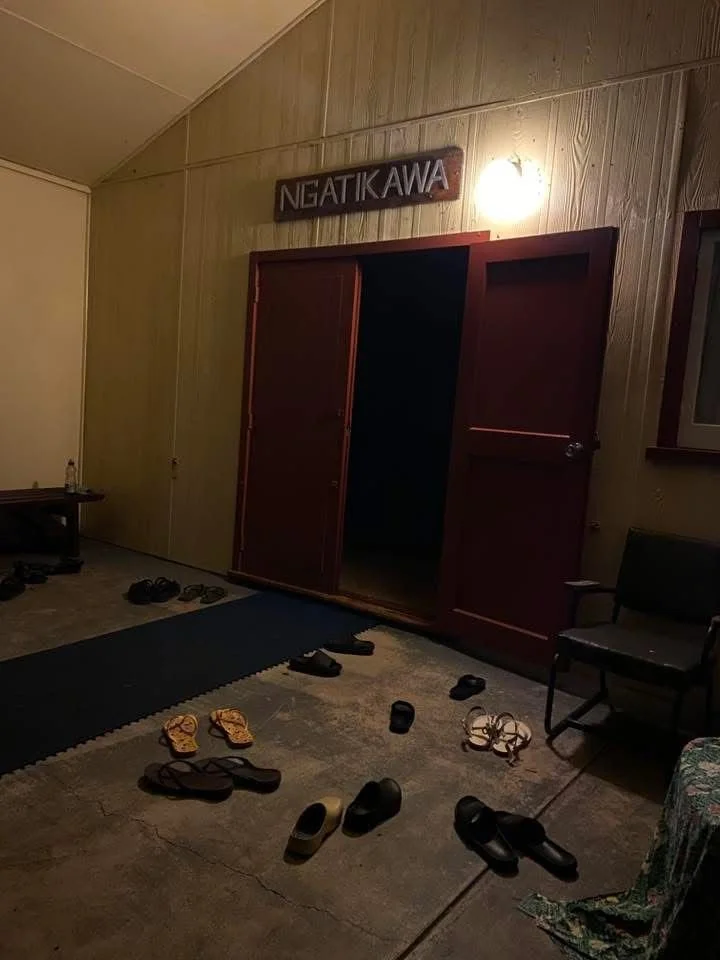
Some shoes from the TTP whānau as we gathered in the wharenui of Oromāhoe marae (Ngāti Kawa, Ngāti Rāhiri, Whānaurara, Ngāre Hauata and Matarahurahu of Ngāpuhi) for the project’s final relational gathering with Indigenous and non-Indigenous participants.
[1] Throughout this report we use hyphens and slashes in English words to remind us of their etymology and therefore their potential – often overlooked in a British settler colonial state where English has become a dominant force in oppression. In this case, breaking down ‘inform’ reminds us that the distribution of knowledge is a material practice – affecting our form and therefore our relation to where we physically are.
[2] Tawhai, 2025
[3] Moana Jackson in correspondence with Mikesh Patel, as quoted in TTP’s ‘Something Awkward’, September 2025
[4] www.lentillab.org
[5] Mertens, 1999, 2008
[6] Noorani & Liebert, 2025
[7] Anzaldúa, 1986
[8] Liebert, 2019
[9] see also Liebert 2019, 2021
[10] See Cram & Mertens, 2016
[11] Glissant, 2006
[12] E.g., Braun & Clarke, 2007
[13] Fanon, 1961
[14] Barad, 2014
[15] Maldanado-Torres, 2016; Liebert, 2019
[16] Mika, 2020
[17] Carlson, Liebert & Reihana, 2025
[18] Huygens, 2007
[19] DiAngelo, 2012
[20] Rubin, 2024
[21] Liebert, 2021
[22] Menakem, 2021
[23] Liebert, 2021
[24] Liebert, 2021
[25] Barad, 2014